14 min read
.png?width=890&height=501&name=ANTI-diverging-path-graphic-v5%20(1).png)
For our second installment of Antibody Discovery in 2026, we follow up on our recent overview of the external forces affecting our industry by looking specifically at the 2025 approved therapeutic drugs themselves. Approvals represent the culmination of discovery efforts, arguably the highest bar for what works and why. We’ve previously reported on antibodies approved in 2022 and later in 2023 and 2024, focusing largely on first-time approvals by governing bodies in the United States, United Kingdom, and European Union. This year, we have expanded our analysis to include approvals in China, a portion of the global market that has shown remarkable growth in recent years, especially when it comes to the approval of new drugs. China’s rapid therapeutic output and international market capture have made it a hot-button issue in the antibody drug development world, so its inclusion in our analysis of 2025 approvals makes it all the more imperative.
While there have been several reviews of 2025 approvals, we will focus our analysis on elements relevant to discovery: the indications, targets, formats, and sources of approved antibodies. As with our previous blogs, we have primarily used the latest edition of Antibodies to Watch as the basis of our analysis. This review always offers an excellent description of newly approved antibody-derived therapeutics, as well as equally absorbing summaries of antibody-based drugs that (at the time of publication) were in the late-stage development pipeline. To supplement our primary source, Antibodies to Watch in 2026, we also looked at the Food and Drug Administration (FDA)’s list of Novel Drug Approvals for 2025 and the British Journal of Pharmacology’s Novel drugs approved by the EMA, the FDA and the MHRA in 2025: A year in review. Our review of innovative antibodies includes new monoclonal antibodies and antibody-based therapies [e.g., antibody drug conjugates (ADCs) and bispecific antibodies], but does not include biosimilars. In a new addition to this year’s analysis, we identify therapeutics we consider “first-in-class” based upon either a novel target, novel mechanism of action, or both.
We hope that, by exploring the patterns we’ve noticed in 2025’s approved antibody-based therapeutics and the trajectories we have observed over time, we can help the discovery community identify opportunities, strategies, practices, and key technologies for success.
Patterns
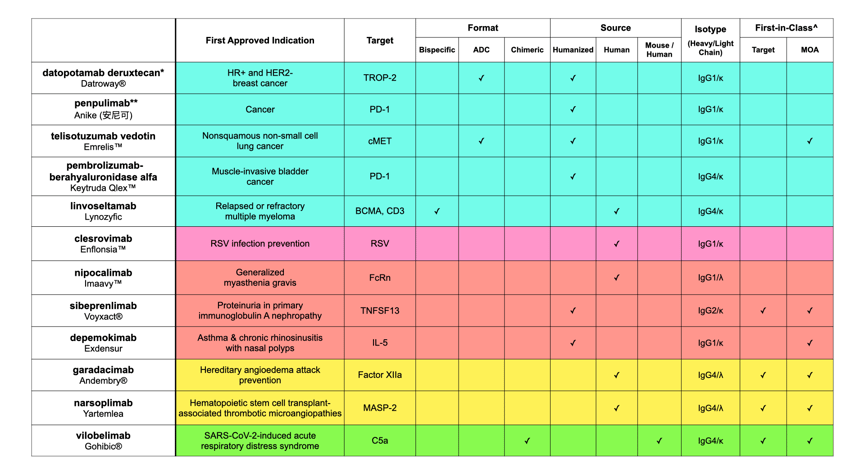
Before we can make any predictions about where antibody drug discovery and development is going, let’s first take a look at where we are. Using data from Antibodies to Watch and the other sources mentioned above, we put together two tables. Table 1 shows therapeutics approved in the United States by the Food and Drug Administration (FDA); in the European Union by the European Medicines Agency (EMA); or in the United Kingdom by the Medicines and Healthcare products Regulatory Agency (MHRA). Table 2 depicts approvals granted by the National Medicinal Products Administration (NMPA). In both tables, you’ll note that we sought to identify the outstanding characteristics of each therapeutic. This includes identifying whether the format of the drug’s antibody base is what Antibodies to Watch refers to as a “highly innovative molecule,” meaning an alternative format such as a bispecific or an ADC. We also sought, where applicable, to identify drugs that can be classified as first-in-class.
Table 1: New Antibody-Based Therapeutics Approved by the FDA, EMA, & MHRA in 2025
.png?width=707&height=54&name=unnamed%20(1).png)
New and novel antibody-based therapies approved by the Food and Drug Administration (FDA) in the United States; the European Medicines Agency (EMA) in the European Union; or the Medicines and Healthcare products Regulatory Agency (MHRA) in the United Kingdom in 2025. Data for this table was pulled from The Antibody Society’s report Antibodies to Watch in 2026 and from the FDA report Novel Drug Approvals for 2025.
Table 2: New Antibody-Based Therapeutics Approved by the NMPA in 2025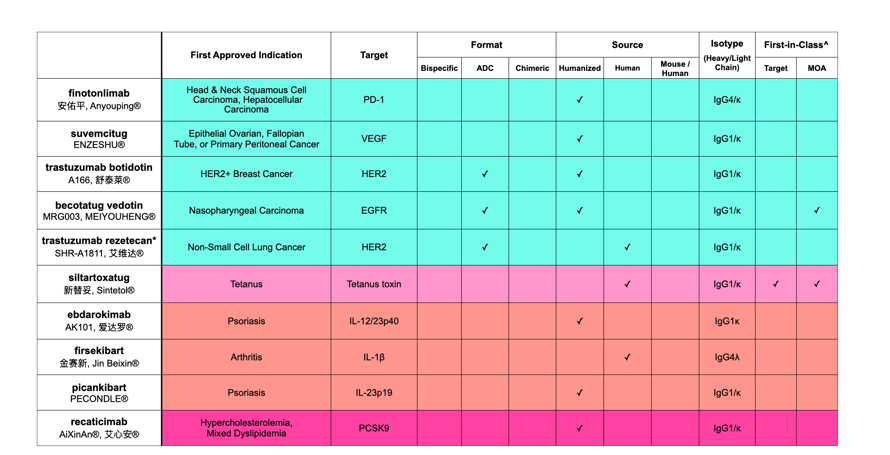
.png?width=670&height=58&name=unnamed%20(2).png)
New and novel antibody therapies approved by China’s National Medicinal Products Administration in 2025. Data for this table was pulled from The Antibody Society’s report Antibodies to Watch in 2026.
A total of twenty-two therapeutic antibodies were approved globally in 2025. Of these, ten are cancer-targeted, six for immune-mediated disorders, two for cardiovascular indications, two for infectious disease, one for hemostasis, and one for metabolic disorders. All drugs in Table 1 were first approvals with the exception of datopotamab deruxtecan (which was approved in Japan in December 2024) and penpulimab (approved in China in 2021). Note also that vilobelimab was approved by the European Medicines Agency (EMA) but has only been granted an Emergency Use Authorization by the FDA. All of the therapeutic antibodies listed in Table 2 received first approval, although the parent antibody for the ADC trastuzumab rezetecan was approved in the US in 1998.
Sources and Attributes of Approved Antibodies
As noted in past reviews, immunized hosts were the sources of most (86%) of approved antibodies. There was one chimeric mouse/human antibody (vilobilimab). Fourteen of the antibodies were humanized: thirteen from mice, and one (suvemcitug) from a rabbit. The remaining seven were fully human, derived from the following sources:
- Two from human antibody-producing transgenic mice (linvoseltamab, forsekibart)
- Two from human B-cells (clesrovimab, siltartoxatug)
- Three from human antibody display libraries (garodacimab, narsoplimab, and genakumab)
Only one antibody has an IgG2 heavy chain isotype (sibeprenlimab), with the remaining approved drugs being approximately one-third IgG4 and two-thirds IgG1. The antibodies overwhelmingly have kappa light chains (18 out of 22).
Approvals of First-in-Class Antibodies
For our analysis of 2025’s first-in-class antibodies, we looked into whether there were prior approved antibodies directed to the same target or with the same mechanism of action. Our criteria for a novel mechanism of action are broad, but include new pathways and new modalities (e.g., ADCs). In keeping with the commonly understood definition of “first-in-class,” we did not include antibodies with an improved format (e.g., higher affinity, fully human, etc.) or alternative delivery or dosing strategy. As we noted earlier, first–in–class drugs are defined primarily by their novel target or mechanism of action.
Based upon these criteria, we identified five antibodies that we view as first-in-class based on their targets. Four were approved by the FDA and one by the NMPA. They are:
- sibeprenlimab (TNFSF13)
- garadacimab (Factor XIIa)
- narsoplimab (MASP2)
- vilobelimab (Complement 5a)
- siltartoxatug (Tetanus Toxin)
Additionally, there are eight antibodies that we recognized as first-in-class for their mechanism of action. Some overlap with first-in-class target antibodies. Six were approved by the FDA and two by the NMPA. They are:
- telistotuzumab vedotin (cMet protein ADC)
- sibeprenlimab (inhibits survival and maturation of B-cells)
- depemokinab (ultra-long-acting IL-5 inhibitor)
- garadacimab (inhibits Factor XIIa)
- narsoplimab (inhibits lectin pathway in the complement system)
- vilobelimab (blocks pro-inflammatory activity of C5a)
- becogatug vedotin (EGFR-targeted ADC)
- siltartoxatug (inhibits toxin internalization)
Formatting
Alternative formats constituted a small number of approved drugs, with only a handful of ADCs and one bispecific approved globally in 2025. Two ADCs and one bispecific were approved by the FDA, while three ADCs and zero bispecifics were approved by the NMPA. All bispecific and ADC modalities appeared in therapies with cancer indications. The ADCs use either tubulin disruptors (i.e., vedotin and botidin) or a topoisomerase I inhibitor (i.e., deruxtucan and rexetecan) as their toxin. Telisotuzumab vedotin is a first-in-class c-Met protein-directed ADC, while becotatug vedotin holds the distinction of being the world's first approved EGFR-targeted ADC.
The year’s lone bispecific approval, linvoseltamab, consists of two identical human kappa (κ) light chains and two different heavy chains, one specific for BCMA (a marker located on multiple myeloma cells) and the other for CD3 (a marker located on T-cells). Linvoseltamab was discovered before fixed light chain mice were available using a screening strategy of cross-pairing the cognate heavy with non-cognate light chains to find a light chain compatible with both. While linvoseltamab is not the first approved BCMA x CD3 bispecific, it received accelerated approval based upon the strong patient response rate.
Finally, while anti-tetanus immunoglobulin from horse or human plasma has been approved for decades, siltartoxatug is the first monoclonal antibody for tetanus prophylaxis, making for an easier-to-produce tetanus treatment.
Trajectories
The attributes of recent antibody drug approvals can give us a sense of where therapeutic antibody trends may be headed. Some of those results might even be a bit counterintuitive. We have seen, for instance, a steady string of US and EU approvals: twelve in 2022 and thirteen in 2023, with a dip down to just nine in 2024 before rising again to twelve last year. Meanwhile, there has been a gradual decrease in the percentage of approved antibody-based drugs targeting cancer compared to non-cancer-targeted drugs (from roughly 50% to 25%). By contrast, China has accelerated overall antibody-based drug approvals from just five approvals in 2023 to twelve in 2024 before seemingly leveling off at ten in the past year; over this three-year period, the percentage of cancer-targeted drugs compared to non-cancer-targeted drugs has gone from 80%, quickly equalizing to about 50% thereafter. In both markets we have thus seen a relative increase in approvals for non-cancer targeting therapeutics, despite the apparent industry focus on the development of alternative antibody modalities (bispecifics, ADCs, and the like) primarily developed to address the challenges of cancer targets.
Alternative Modalities
Based on the diversity of approved biologics in 2022, and, above-mentioned industry focus on alternative antibody modalities, we’ve long anticipated that we will see a continued rise in these modalities across an ever-increasing range of indications. In 2025, however, there were surprisingly few among the approvals. Only one bispecific and two ADCs achieved FDA or EMA approval, while three ADCs and no bispecifics were approved by the NMPA. This worldwide total of six approvals is down from the nine drugs with alternative modalities approved in 2024 (three bispecific antibodies and one ADC by the FDA/EMA, one bispecific antibody and four ADCs by the NMPA). And, much like the report from 2023, alternative modalities appeared only in cancer-targeted drugs.
Comparing the Strengths of Two Markets
Based on the numbers we discuss in the “Patterns” section above, the US, EU, and UK lead in first-in-class approved antibodies in 2025. Collective approvals for this group of agencies had six antibodies targeting a novel target or mechanism of action compared to the two from China. While all the therapeutic antibodies approved in China are new molecules and firsts for that country, all but two (siltartoxatug and trastuzumab rezetecan) have counterpart antibodies with prior approval in the US and EU.
While the US/EU pipeline is still leading the charge when it comes to truly novel products, China has gained prominence in other ways. Since the start of 2026, China’s global out-licensing deals have grown to a full half of the world market, while US, EU, and Japanese shares declined. How did China get to the point where its output is so prodigious? Factors that may have contributed to this growth include building infrastructure for fast and cost-effective clinical trials; government support and policies including government investment in early-stage biotech; focus on new antibody formats (e.g., bispecifics and ADCs); and homegrown talent returning from overseas.
China has worked to shorten drug development phases by roughly one year while slightly extending review periods by at least a couple of months. The FDA has started its own experiments with the approval process, hoping to shorten it by swapping the traditional advisory committee process with reportedly less-rigorous expert panels and a potentially problematic voucher program that has quietly outlasted its founder.
Approvals in 2026
So far, we have primarily seen the FDA grant approvals for new indications of existing antibody drugs. Novel antibodies to attain FDA approval include the ADC pivekimab sunirine targeting CD123, and a subcutaneous formulation of Isatuximab targeting CD38. In China, notable approvals include the bispecific ADC, izalontamab brengitecan, that simultaneously targets EGFR and HER3, and Amdokitug targeting IL-17A.
What's in the Queue
In addition to approved antibody drugs, Antibodies to Watch in 2026 highlights twenty-six investigational antibody therapeutics (five cancer-targeted, twenty-one non-cancer) that are, as of publication, undergoing first regulatory review. These candidates share many similarities with the 2025 approved drugs, with most of the twenty-six therapeutics in regulatory review being humanized (66%), overwhelmingly IgG1, and having kappa light chains. The non-traditional formats that appear in the list include:
- Four bispecifics (1 US/EU, 1 Japan, 2 China)
- One ADC (US/EU)
- One bispecific ADC combo (China)
- One bifunctional antibody with a receptor antibody complex (China)
Looking Ahead
What conclusions can we draw from our look at 2025 approved antibody-based therapeutics?
Based entirely on approvals from 2025, you might not get the first impression that highly innovative molecules are the driving force for innovation that we previously assumed. They make up a small number of therapeutics, all of which are cancer-targeted (an area where their application is already well established). The authors of Antibodies to Watch in 2026 describe being “cautiously optimistic that the highly innovative antibody therapeutics currently in development…may prove more successful than earlier versions,” and we are inclined to agree. Even as the number of approved drugs from alternative antibody modalities fluctuates, we think it’s a safe bet that more organizations will be pursuing alternative antibody modalities for their novel therapeutics, eventually delivering increased regulatory success. How exactly we get there – and how fast – remains to be seen.
We expect that the Chinese drug pipeline, along with direct collaboration between U.S. and Chinese companies, will not only continue but become more prevalent. There are forces both for and against China’s growth and influence from both national and international points of view. But, whether one agrees or disagrees with governmental policies, the reality is that China’s global impact and import is on the rise. Even looking at international nonproprietary names (INN) of China’s 2025 approved drugs gives a hint to the speed that China is developing drugs: The WHO formally announced in May of 2022 an update of the INN naming scheme that completely phases out -mab as a suffix, replacing it with four new suffixes. We can see in Table 2, that five of the drugs employ this updated INN naming scheme, implying these drugs went from Phase I (traditional INN application period) to approved in just three or four years rather than the FDA average of six to eight.
There is an argument to be made that the US and Europe are still leading in innovative antibody therapeutics. When it comes to the actual approval of drugs, however, we are seeing a slowing down of the process in the US. This appears to be due, in part, to bureaucratic slow downs and other shakeups at the federal level. We suspect that, while the quality of US therapeutics isn’t diminishing, the limited ability to process drug approvals at the federal level will likely mean fewer approved drugs in the 2026 calendar year.
No matter what the future holds, the need for novel antibody-based therapeutics remains. Antibody Solutions will continue to monitor trends and provide innovation that responds to those trends. We’d love to hear your thoughts about what approvals in 2025 have looked like and where you think they’re headed. You can always reach out and talk with us about how we can help you pursue your own novel therapeutic targets.